
The latest AI writing statistics tell a clear story: almost everyone who publishes online now uses AI to help write. 92.4% of bloggers use AI for their blog content, according to Orbit Media’s 2026 survey. 86.4% of marketing teams use it in at least a few areas, and content creation is one of the top uses (HubSpot, 2026).
But the people getting results don’t publish raw AI text. Only 7% of working writers say they have published AI-generated text. And as of October 2026, Google’s guidance says it is “critical to manually factcheck and review all AI-generated content” before publishing.
So who are these users, why do they use AI, and what do they actually need from it? Here’s the breakdown by group, with the numbers behind each one.
Table of Contents
Small businesses and marketing teams
This is the biggest group by far. HubSpot’s 2026 State of Marketing report surveyed more than 1,500 marketers: 86.4% of teams use AI in at least a few areas, and 42.5% use it extensively for content creation. 83.5% of marketers are expected to produce more content, and about a third say AI saves them 10 to 14 hours a week.
Across all US businesses, adoption is lower but climbing with company size. The US Census Bureau’s Business Trends and Outlook Survey puts AI use at 19.8% of businesses nationally, and 37% among firms with 250 or more employees (May 2026).
Why they use it: the pressure is volume. A company blog needs steady posts to keep showing up in search, and most small teams don’t have a full-time writer.
How they use it day to day: most small teams start with the jobs nobody has time for. A plumber, a dental clinic or a local SaaS company knows its customers ask the same questions every week, but nobody on staff has hours to turn those answers into blog posts. AI fills that gap. A typical setup is one person picking topics once a month, the tool drafting the posts, and a manager reading each one before it goes live. Marketing teams at larger companies use the same pattern at higher volume, adding product pages, help articles and email copy on top of the blog.
What they need: a blog that keeps running without someone sitting down to write every post. That means research, writing, images and publishing handled in one place.
How Draft2Publish-AI fits: you pick your categories and content types and set a weekly schedule. Each article is researched from live sources, written, given SEO metadata and a featured image, and published to WordPress. The free plan schedules up to 3 articles a week as drafts for your review. Pro adds automatic publishing and all 7 days.
Bloggers and content creators
Bloggers adopted AI early and almost completely. Orbit Media’s 2026 blogger survey (1,042 respondents) found 92.4% use AI for blogging. Its most interesting finding: AI users and non-users were equally likely to report strong results. The tool alone doesn’t make the difference. How you use it does.
Bloggers are also the most vocal about what goes wrong. One r/Blogging post put it plainly: “AI writing all sounds like the same person wrote it.” The same writer described rewriting half of every draft to remove the words they’d never use.
Why they use it: to post consistently without burning out, and to get past the blank page.
How they use it day to day: a typical blogger uses AI at several points in the process rather than for one big task. It suggests topics when the idea list runs dry, builds an outline, drafts sections they find tedious, writes meta descriptions and turns a finished post into social captions. The writing that carries their opinion and experience usually stays their own. Many bloggers say the biggest change is consistency: instead of posting when inspiration hits, they keep a steady schedule because the slow parts take less time.
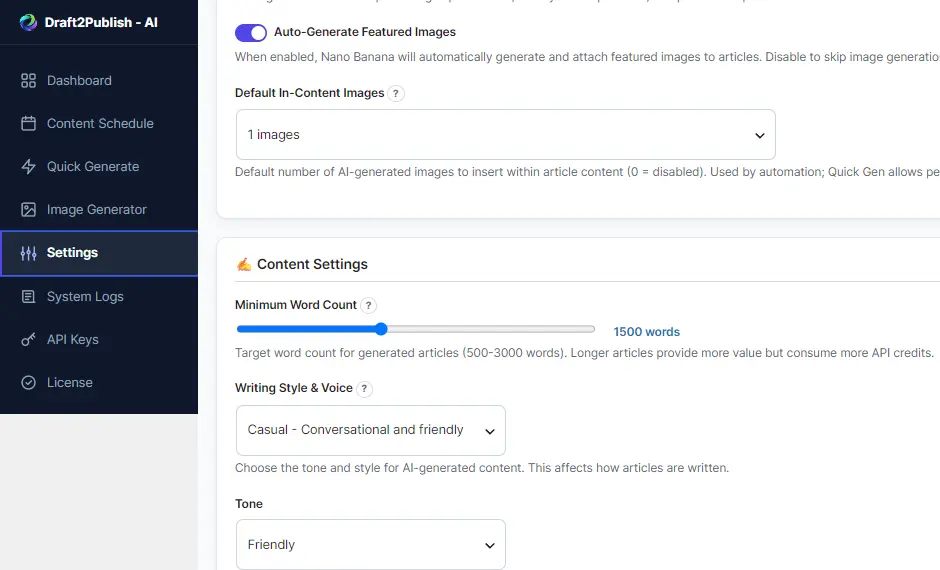
What they need: help that still sounds like their site.
How Draft2Publish-AI fits: Writing Style & Voice is a setting you choose once (engaging, casual, professional, technical, educational or informational), so every article reads the same way. Ten content types, from how-to and review to opinion and listicle, set the structure. You can start on the free plan from WordPress.org, which includes scheduled drafts up to 3 days a week.
Niche and affiliate site owners
Niche site owners treat content as an operating cost. They care about cost per article, publishing volume and not repeating themselves across hundreds of posts.
Why they use it: to cover a topic fully, faster than they could write it.
How they use it day to day: niche site owners usually plan in topic clusters. They map out every question a reader might have about a subject, such as every way to care for a specific houseplant, then fill in the articles one by one. AI makes it realistic to cover a whole cluster in weeks instead of months. The work that stays human is choosing which topics are worth covering, checking product details and deciding how articles link together so readers, and search engines, can move through the site.
What they need: low and predictable costs, internal links that tie the site together, and no duplicate or recycled sources.
How Draft2Publish-AI fits: you bring your own AI key and pay the provider directly, with zero markup on AI spend. The internal link step reads your existing WordPress posts and links to them where they fit. Primary Source Memory keeps track of sources already used, so new articles don’t keep citing the same ones. For a full breakdown of what an article costs to produce, see our AI content cost per article guide.
Professional writers and freelancers
Professional writers use AI more carefully than any other group. The “AI and the Writing Profession” survey, commissioned by Gotham Ghostwriters and Bernoff.com (1,481 working writers), found that 61% use AI tools, reporting an average 31% productivity gain. Yet only 7% have published AI-generated text. The heaviest users are thought leadership writers (84%), PR and communications professionals (73%) and content marketing writers (73%).
Why they use it: research and first drafts, the slow parts of the job.
How they use it day to day: professional writers treat AI like a research assistant and a first reader. They use it to summarize long reports, find angles on a brief, organize interview notes and test different structures before committing to one. When they draft with AI, they rewrite heavily, which is why so few publish the output directly. For freelancers, the gain is time: getting through research faster means more room for the parts clients actually pay for, which is judgment, voice and accuracy.
What they need: a draft built on sources they can check, so the time saved isn’t lost to fact-checking afterwards.
How Draft2Publish-AI fits: every article starts from research. Sources are checked for dead links and freshness, and verified, before anything is written, facts are pulled from those sources, and the article ends with a Sources list. Quick Generate lets you write a single article on demand, with Custom Instructions for anything specific to the piece.
News organizations and publishers
Newsrooms use AI mostly behind the scenes. In the Reuters Institute’s Journalism, Media and Technology Trends and Predictions 2026 report (280 digital leaders in 51 countries), back-end automation such as transcription, copyediting and metadata was the most common use, named by 64%.
Publishers also face a traffic problem. The same report cites Chartbeat data showing Google organic traffic to more than 2,500 sites fell 33% globally between November 2024 and November 2025, and publishers expect search traffic to fall by more than 40% over the next three years.
Why they use it: speed on fast-moving stories, and more output from smaller teams.
How they use it day to day: inside a newsroom, AI mostly handles the work around the story rather than the story itself. Transcribing interviews, suggesting headlines, writing metadata, tagging archives and producing short summaries are common uses. Some publishers also use it to turn structured data, such as earnings results, sports scores or weather alerts, into short reports. The reporting, sourcing and final editorial call stay with journalists, because a newsroom’s credibility depends on getting facts right the first time.
What they need: accuracy above everything. A wrong fact in a news story costs more than a slow one.
How Draft2Publish-AI fits: the News content type writes in inverted pyramid style, with the key facts first. Sources go through freshness and verification checks, and the finished article’s claims, including its title, meta description and excerpt, are checked against those sources before it is saved. Every run is recorded in System Logs, so you can see exactly what happened.
Agencies and SEO professionals
Agencies manage content for many clients at once. Their challenge is less about writing one good article and more about producing consistent, optimized articles across several sites.
Why they use it: to scale content for clients without scaling headcount.
How they use it day to day: an agency might manage a dozen client blogs, each with its own audience, niche and brand rules. AI helps them keep every site publishing on schedule without hiring a writer per client. The usual workflow is keyword and topic research by the SEO team, briefs per client, AI-assisted drafts, then an editor checking facts and brand fit before anything goes out. Agencies also use AI on the technical side: titles, meta descriptions, FAQ sections and schema that would take hours to write by hand across many sites.
What they need: multi-site support, solid on-page SEO and output that holds up for clients.
How Draft2Publish-AI fits: the Agency plan covers 5 sites with unlimited articles. Each article gets an SEO title, meta description and excerpt, FAQ schema where it fits, and GEO formatting so AI answer engines can cite it. Each site keeps its own categories, schedule and writing style.
Experts and enthusiasts
Some of the best content online comes from people who know a subject deeply but don’t enjoy writing: hobby experts, founders, practitioners. For them, AI is a way to turn knowledge into published posts.
Why they use it: they have the expertise but not the time or the habit of writing.
How they use it day to day: a retired engineer writing about model trains, a nurse running a health blog or a founder explaining their industry all have the same problem: deep knowledge, little time to write. They often start by setting the topics and the angle, letting the tool research and draft, then adding their own corrections and experience before publishing. The result is content that carries real expertise without requiring them to become full-time writers.
What they need: a tool that follows their direction and keeps their site’s standards.
How Draft2Publish-AI fits: Custom Instructions in Quick Generate let you add your own angle to any article. On Pro, Editorial Memory stores rules the writer follows on every article, such as terms to use, words to avoid or how to handle certain topics.
What every group has in common: checking before publishing
AI writing is now part of the web itself. Pew Research found about 10% of the web pages in a July 2026 snapshot show significant signs of AI authorship, and over a third of pages published since ChatGPT launched show those signs (August 2026).
That’s why Google updated its guidance on October 1, 2026: “It is critical to manually factcheck and review all AI-generated content for accuracy and trustworthiness before publishing.” The review applies to titles, meta descriptions, structured data and image alt text too.
Whatever group you’re in, the line between AI content that helps and AI content that hurts is the same: is it built on real sources, and was it checked?
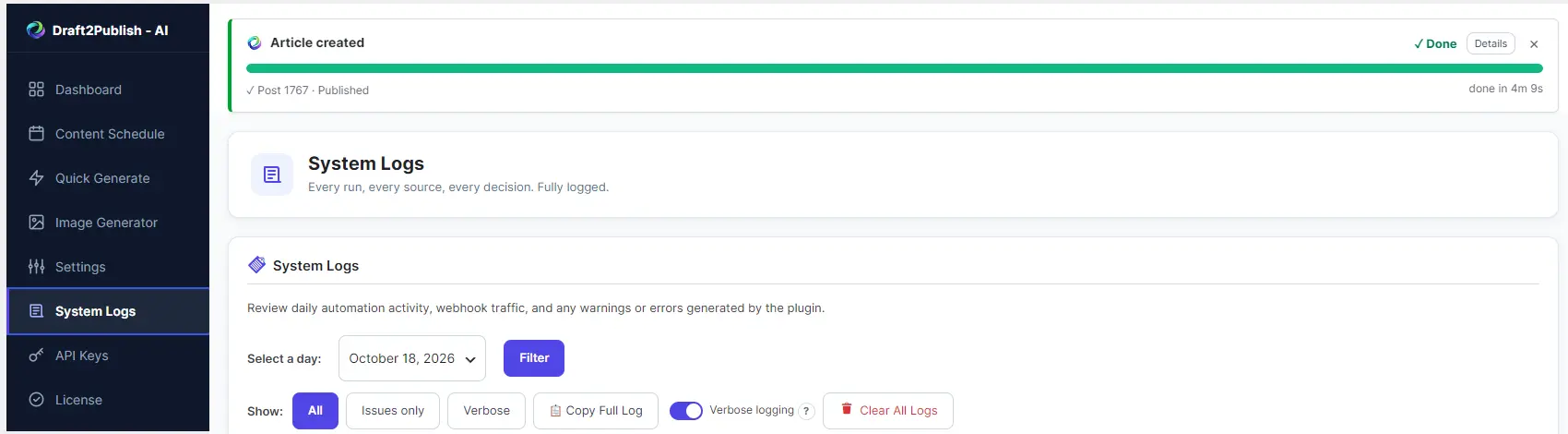
Draft2Publish-AI is built around that. It finds and verifies sources before it writes, and it checks the finished article’s claims against those sources before saving it. You still review the article. It just makes that review fast, because the sources are right there.
How to choose an AI writing tool for your situation
Ask yourself five questions:
- How much do you publish? One post a month needs a writing assistant. Several a week needs a workflow that handles research and publishing too.
- Do your readers expect sources? If accuracy matters in your niche, choose a tool that researches before it writes.
- Where do you publish? If it’s WordPress, a plugin that publishes directly saves a copy-paste step on every post.
- How do you want to pay? Subscriptions with credits mark up AI costs. Bring-your-own-key tools let you pay the provider directly.
- Does it match your style? Look for a setting you configure once, so every article sounds the same.
For a side-by-side look at WordPress options, see our guide to autoblogging tools for WordPress.
AI writing statistics FAQ
Who uses AI writing tools the most?
Marketers and bloggers. 92.4% of bloggers (Orbit Media, 2026) and 86.4% of marketing teams (HubSpot, 2026) use AI. Among professional writers, thought leadership writers use it most, at 84%.
Is AI-written content bad for SEO?
Not by itself. Google’s guidance focuses on whether content is accurate and useful, and asks publishers to fact-check and review all AI-generated content before publishing. Content built on verified sources and reviewed by a person is what holds up.
Do professional writers use AI?
Yes. 61% of the 1,481 writers surveyed use AI tools, but only 7% have published AI-generated text, according to the survey commissioned by Gotham Ghostwriters and Bernoff.com. Most use it for research and drafting.
Can AI write in my site’s voice?
Yes, if the tool lets you set a style. In Draft2Publish-AI, Writing Style & Voice is set once in Settings and applies to every scheduled article.
Try it on your own site
Sourced articles, written and published for you
- Finds and verifies sources before it writes
- Writes in the style and tone you set once
- Publishes straight to WordPress, on your schedule
Sources
- Orbit Media, 2026 Blogging Statistics
- HubSpot, State of Marketing 2026
- US Census Bureau, AI use by businesses (May 2026)
- Publishers Weekly on the Gotham Ghostwriters / Bernoff survey
- Reuters Institute, Journalism, Media and Technology Trends and Predictions 2026
- Pew Research Center Data Labs, How Much of the Internet Is Written With AI? (Aug 2026)
- Google Search Central, Using generative AI content
- r/Blogging, “AI writing all sounds like the same person wrote it”